How it works
No code, no paperwork and no custody of your funds. This is everything that happens between having the idea and your memetoken trading on chain — on Ethereum, Base, Arbitrum or Robinhood Chain.
Step 1
Bring your own wallet — that's the whole sign-up.
Your wallet is your account. Connect one you already have and you're in — no forms, no passwords to forget, no email to hand over. We never take custody of your funds: everything you sign, you sign yourself.
Works with the usual wallets in the ecosystem
Step 2
Name, symbol, supply — and the chain it lives on.
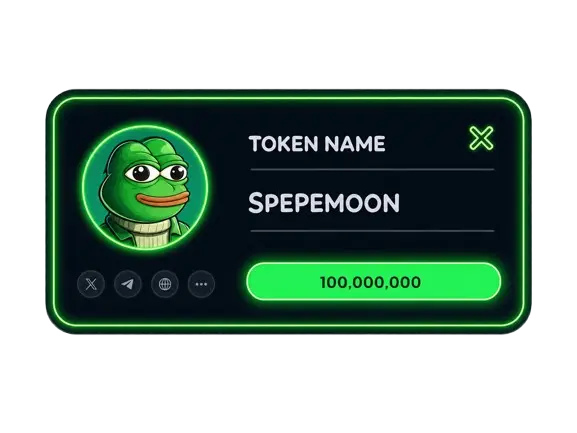
Pick the chain to deploy on (Ethereum, Base, Arbitrum or Robinhood Chain), fill in name, symbol and total supply, and choose the pair token from the whitelist the contract publishes for that chain — WETH everywhere today, plus USDG on Robinhood Chain. 100% of the supply ends up pooled or burned: there is no team allocation, ever.
Step 3
Starting price, trading fee, price curve and a permanent floor.
Set the starting price in plain USD — for WETH pairs we convert it using the Chainlink ETH/USD price (a stablecoin pair needs no conversion) and show you the resulting market cap. Pick the trading fee your pool will charge, from 0.3% to 3%: you choose it once, it freezes in the pool and it's the number every trader pays. Then pick how far the price can climb: 1,000x, 10,000x or 100,000x above your starting price. A wider range spreads the same supply over more price, so a given buy walks up worse prices and reaches less of it — and the range sets the hard market cap ceiling of your pool. It's the only shape decision you make: the number of price bands is fixed, because it changes launch gas and nothing a buyer would notice. The price floor is the one thing you don't configure: every launch buys and burns your token at launch with a fixed budget — the network minimum for your pair token — locking in a floor that can only ever go up. There's no input because there's no decision worth making: a bigger genesis buy just buries your own money in a position nobody can ever touch, while the symbolic minimum already does the whole job of seeding the price and burning the dust. We show you the floor price it lands on and how much of your supply it burns before you sign.
Sensible presets everywhere — an Advanced toggle exposes the raw ticks if you want them
Step 4
One signature and your token is live and tradable.
You review the summary — including the hard ceiling of your curve, the market cap above which no liquidity exists — sign one transaction and the contract deploys with its liquidity already in place, tradable from the very first block. The floor buy happens inside the same transaction, before anyone else can trade, so it can't be front-run. You pay the network gas, the fixed genesis floor buy and the protocol's creation fee for that chain — both amounts read live from the contract and shown in the summary, so you always see the exact number before signing. On chains where the tandem launcher is deployed you can also open a second official pool in that same transaction: it buys your token at market and locks it as sell-side depth, so arbitrage bots have two official venues to keep in line. It costs the creation fee twice plus your committed buy, and only those two pools are protected — any other pool someone opens for your token is unofficial and its liquidity can be pulled.
The LP fee and the fee split commitment you pick are baked into the pool forever — review them before signing
Step 5
This is where the real fun starts.
Your token shows up in Explore with its profile, avatar and live metrics across every supported chain. Share the link and let the community do the rest (a Trending ranking is on the roadmap, not live yet). Every trade pays the LP fee you set — and 90% of claimed fees go to you as the creator, forever. Each claim pays both sides of the pair: part of what you earn arrives as the pair token (WETH, or USDG on Robinhood Chain), so you have income without selling a single token of your own. No allocation needed: your income scales with volume.
Unless you launched with the quote-only commitment, in which case you collect the pair-token side and the token side is burned on every claim